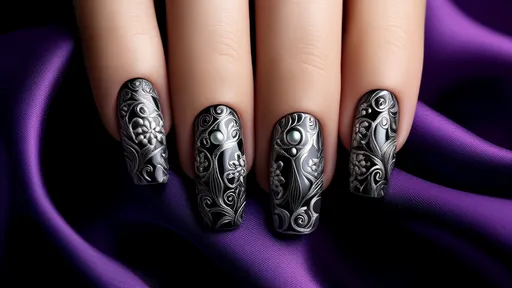
In the ever-evolving world of beauty and self-expression, high-end nail art has transcended mere polish and embellishments to become a canvas for intricate micro-sculptures. What was once a simple manicure has now blossomed into a breathtaking art form, where nails serve as tiny galleries for avant-garde designs. This fusion of craftsmanship and creativity has given rise to what industry insiders are calling "haute couture for nails" – a realm where meticulous detailing meets boundless imagination.
The concept of nail art as miniature sculpture isn’t entirely new, but recent advancements in materials and techniques have pushed the boundaries of what’s possible. Artists now employ resins, acrylics, and even precious metals to construct three-dimensional masterpieces that cling delicately to the nail bed. From cascading floral arrangements to abstract architectural forms, these designs often take hours—sometimes days—to complete, transforming fingertips into wearable art installations.
What sets this movement apart is its deliberate blurring of lines between beauty and fine art. Leading nail sculptors like Mei Kawajiri and Sojin Oh have gained recognition not just within the beauty industry but in contemporary art circles as well. Their work challenges perceptions, asking whether something so small and transient can carry the same artistic weight as traditional mediums. Galleries in Tokyo and New York have begun featuring nail art exhibitions, where magnified projections reveal the staggering detail invisible to the naked eye.
The technical precision required for these creations would make even seasoned jewelers pause. Artists work under magnification, using tools adapted from dentistry and micro-engineering to place individual elements sometimes smaller than a grain of sand. The process resembles watchmaking more than conventional nail design, with some pieces involving over 200 precisely placed components. This microscopic attention to detail explains why clients might pay upwards of $500 for a single sculpted nail in fashion capitals like Paris or Dubai.
Cultural influences play a significant role in shaping these miniature artworks. Japanese artists often draw inspiration from ikebana and netsuke carvings, creating asymmetrical designs with negative space. European practitioners frequently reference Baroque ornamentation or Art Deco geometry. Meanwhile, African-inspired designs incorporate beadwork patterns translated into micro-bead clusters. This global exchange of ideas has created a rich visual language specific to nail sculpture that continues to evolve seasonally.
Social media has served as both catalyst and canvas for this movement. Platforms like Instagram allow artists to share hyper-zoomed videos showcasing their techniques—the careful layering of translucent gels to mimic stained glass, or the strategic placement of micro-mirrors to create optical illusions. Viral designs spawn international trends overnight, with beauty bloggers dissecting the methods behind particularly groundbreaking pieces. Yet despite its digital proliferation, the essence of the craft remains resolutely tactile and painstakingly manual.
The environmental impact of such intricate designs hasn’t gone unnoticed. Forward-thinking studios now develop biodegradable alternatives to traditional acrylics and experiment with plant-based resins. Some collaborate with jewelers to create permanent metal sculptures that can be removed and reattached, reducing waste. This sustainability focus adds another layer of innovation to an already groundbreaking field, proving that luxury and ecological responsibility can coexist—even at microscopic scales.
As the distinction between accessory and art object continues to dissolve, nail sculpture stands poised to redefine how we perceive adornment. Museums have begun acquiring notable designs for their permanent collections, while fashion houses commission custom sets to complement runway looks. What began as a beauty trend has matured into a legitimate artistic discipline, one that challenges our notions of scale, permanence, and where we choose to place cultural value. The fingernail, it seems, has become the unlikeliest of canvases for the next wave of artistic innovation.
Behind every extraordinary set lies an often-overlooked aspect: the anatomical considerations. Master sculptors must account for nail curvature, growth patterns, and daily wear when designing pieces. Some create flexible frameworks that move naturally with the nail, while others engineer lightweight supports for more elaborate constructions. This marriage of ergonomics and aesthetics represents perhaps the most ingenious facet of the craft—ensuring that these wearable sculptures remain comfortable despite their complexity.
The psychological impact of such transformative adornment shouldn’t be underestimated. Clients frequently describe the experience of wearing sculpted nails as unexpectedly empowering—a daily reminder of artistry carried with them. For some, it becomes a form of self-curation, with designs reflecting personal milestones or emotional states. Therapists have noted its therapeutic potential, especially for individuals recovering from trauma who use the designs as symbolic representations of healing.
Looking ahead, technological integration appears inevitable. Prototypes already exist for nails with embedded micro-LEDs or touch-sensitive surfaces that interact with smart devices. Material scientists are experimenting with color-shifting compounds that respond to body temperature or mood. As these innovations mature, the line between accessory and interface may blur completely, positioning the humble fingernail as a frontier for both artistic and technological expression.
What began as an extravagant beauty trend has undeniably evolved into something far more significant. These miniature masterpieces challenge our perceptions of where art belongs and how it should be experienced. In an age of digital saturation, perhaps there’s something profoundly human about cherishing physical creations so delicate they demand our full attention—reminding us that true artistry thrives not in size, but in vision and execution. The future of nail sculpture gleams with possibility, limited only by the imagination of those daring enough to work on such an intimate scale.
By /Aug 13, 2025
By /Aug 13, 2025

By /Aug 13, 2025

By /Aug 13, 2025

By /Aug 13, 2025
By /Aug 13, 2025

By /Aug 13, 2025

By /Aug 13, 2025

By /Aug 13, 2025

By /Aug 13, 2025

By /Aug 13, 2025

By /Aug 13, 2025
By /Aug 13, 2025
By /Aug 13, 2025

By /Aug 13, 2025

By /Aug 13, 2025

By /Aug 13, 2025

By /Aug 13, 2025

By /Aug 13, 2025

By /Aug 13, 2025
